I am again in a holding pattern, waiting for the Opthalmologist office to call and book my surgery. I was ready to pay pre op for the fees ($2k - $2600k depending on toric or non toric), but now a month later…
It appears that my eye has gone downhill so badly, there is now a discrepancy on whether I need a toric, or just the plain synergy. BUT!!! Now there is the Synergy toric ii lens available, which I am reading is much better, but the OPTH says its not available in Canada yet? I though all the newest lens’s were all approved for Canada / USA including the toric ii. I guess after waiting 1.5 years till this point for surgery, I am mostly blind in that eye, so what’s another few weeks for good vision - and I am not one to decide what lens I require. One thing that stands out to me, is how the lens is being marketed, with famous movie stars, videos by legit doctors with ONLY incredible results post surgery. BUT, then you read reviews from supposed patients (they could be simply paid negative reviewers, who knows?) and the results are not so spectacular. In this thread alone, there are several people who are not happy with the Synergy lens. I wish I could simply write a letter to Tim Roth (Quentin Tarantino movies) who had two synergy lens implanted and went from near blind to 20/20, and find out what his post results were and if he is still happy. Does he have halos and glare at night as described by most patients? There was no post video done after his surgery, just the videos from the procedure, and his overjoyed vision the next day. This was done in Croatia 2 years ago roughly speaking. I am a fan of his fine acting, & hopefully, the video was not also fine acting  LOL, he is such a good actor, we probably would not know the diff
  My doctor assured me, that I will have halos and glare at night, with any of these mf iol’s - and explained in great detail why.
Sad to hear how much this procedure costs in the USA, I feel so bad for my south of the border buddies that have little for health care. Individual provinces in Canada, have different health care plans. Noted, it appears a lot cheaper in Alberta to get Cataract surgery done with multi focal iol’s . In BC, people have to pay a monthly fee for healthcare, which is supposed to be free! Canada is a little inconsistent in such ways. MSP pays 100% for mono-focal lens - which again, only provides one clear point of vision - sans glasses.
It is my wish that our food and drug admin, puts a little bit more care into ensuring all Canadians have an equal opportunity for the best vision possible. People that pay taxes should not have to pay for vision, period. Justin Trudeau, if your listening, time to upgrade such services to Canadians - especially eye care. Why should the rich only (or people with a few thousand bucks to kill, maybe not rich, lol - not me, its going on my stupid credit card) are the only people who can afford to see???
This is very encouraging. Thank you for the update. I am trying to come up with a time window to take off for my return back to work after surgery in one eye. They said some people only need a couple days, but sounds like I should take a whole week off just in case. Wishing for 20/20 vision, my left eye is so bad now, it works only at exactly 2" - every other zone is in a thick cloud with giant swirly halos - its like a perma-acid trip, swirly undistinguishable shapes and circles.
Cheers
I found this webpage ( Synergy IOL Review | The Complete Patient Guide ), it appears to be accurate and honest about halos, glare, night vision. I cannot say if its fully legit, but seems so. I question all information available for free on the internet, to keep my sanity.
There is nothing I can find on manufacturers pages re synergy, to warn of night time side effects, but my doc was very adamant about the definite possibility of annoying night time vision. At this point, my bad eye awaiting surgery has halos and horrible glare, & when its sunny, so bright I must wear sunglasses. Driving is not possible at night time, and if its raining hard and cloudy, forget it. It only works at about 3-5 inches, and glasses have no effect for improvement… so, any improvement for me will be a plus post surgery. Looks like might be in less than two weeks. Wish me luck.
Had the Synergy implanted for 10 weeks in one eye. I will be as detailed as possible, and hope it helps others deciding. I have zero relations or compensation with J&J or Alcon or any lens manufacturer or eye clinics.
The following is about the Synergy lens after it was implanted in one eye.
Visual acuity operated eye: 20/20 tested but likely slightly better (I wasnt trying too hard)
Observations are at 10 week mark for Visual QUALITY. In case some of you dont know, you can have 20/20 and still have crappy visual quality.
Day time:
There is a constant white haze that is rather unpleasant. Colors are flat compared to my natural eye that hasnt had surgery yet. Best way to describe it is if your TV is using a 10 bit panel for best color accuracy, then this would be like downgrading your TV to a 6 bit panel. I get a constant headaches just looking through this operated eye because things just look unnatural and color flat.
During day time I see halos and starbursts if there is a bright car light aimed at me. I see halos around rocks laying on the road. I see halos on a reflection off a piece of metal.
Disregarding halos and starbursts seen during the day, I would give the lens a Rating 6/10 for day time compared to my natural eye due to poor visual quality compared to my natural eye. My opinion is that if you’re an artist or enjoy nature watching then get a monofocal or enhanced monofocal lens instead of the Synergy for natural vibrant colors. The Panoptix from research also has poor visual quality due to the compromises made to get the full intermediate and near vision ranges.
Night time:
Almost every light source or reflection of a light source has Halo + layers of stacked lens rings + starbursts going through the stacked lens rings. (The Lens rings you see allow you to get near vision). A stop light 30 meters away will now look 10-15x larger because of these visual anomalies. I would see Halo + layers of lens rings + starbursts for stop lights, headlights of cars , headlights on rear mirror, brake lights of cars, street lamps, and LED signs of restaurants.
This made driving unsafe. The halos lessened a bit over 10 weeks, but was still there. Talking to two eye surgeons both said the lens rings and starbursts and what halos I saw are permanent and my mind might adjust to it eventually but there will be no further improvement outside of mental adjustment.
Rating 4/10. I understand everyone’s experience can be different when it comes to visual artifacts from the lens, but with what I experienced I would say dont use the Synergy if you plan to do any driving, or if you enjoy going out at night time. Go search on youtube about Synergy and one eye doctor was interviewing a patient that had the Synergy in one eye and Panoptix in other eye. Patient said if he had to do it all over again he would choose the Panoptix because he needs to drive at night. Panoptix seems to be better tolerated for visual artifacts according to most surgeons.
Reading Text on a computer screen:
Fuzzy. This is despite being tested for good close vision and far vision. All text had ghost images around it, making numbers impossible to decipher unless I am around 37 cm from screen. Working from spreadsheets is a lost cause even at 10 week mark.
Rating: 5/10 suitable for occasional reading of news articles and cell phone messages but dont use this lens for serious coding or financial work.
Other comments:
For me, the straw that broke the camel’s back is when I was seeing halos even around a simulated light source in a movie playing on my computer screen. I might be able to escape night time visual anomalies by staying indoors, but to see this garbage while watching a movie at home??? Unacceptable.
Thank you for your detailed report! It will help others.
I’m suffering myself from trifocal implants. My halo experience is similiar to yours. Nightdriving is a nightmare now and it didn’t improve within the last 12 months since the surgery. Intermediate vision doesn’t work well. I need readers on top of my far specs. The far specs are needed because they didn’t hit the refraction point in both eyes and left me with significant residual astigmatism. I got floaters because of the surgery. Positive dysphotopsia, which means I can see the edges of the IOLs when it’s dark. Contrast loss is an issue. Ghosting I have as well. As you said: The whole performance is unacceptable and I wasn’t told the truth before the surgery. The Synergy was and is praisded with seamless vision from 33cm till far, reduced halos and no contrast loss. Good to have reports like yours about the real outcome.
I’ve just read through this entire thread and found it enlightening. I’m 67, live in the US and I’m scheduled to have a RLE in several days but can still back away. I had mono-vision Lasik surgery years ago, have fairly good intermediate and far vision now but am presbyopic and would like to better see the golf ball at address and I’m a big reader of printed books, not iPads. I have only an early cataract in my dominant right eye, which has lowered it to the weaker of the two for distance now–and of course the cataract will get worse over time. So I fall in the category of doing this now to rid myself of spectacles. I’m under the care of a respectable eye surgical center and surgeon, and they have prescribed T. Synergy for both eyes to be done in one sitting next week. Oh yeah, and it’ll cost me about USD 15,000.
My hesitancy has led me to this thread. The hesitancy WAS that I would get these new highly touted lenses installed and then something newer and grander would come over the horizon in the months I was still recovering (maybe something that would mitigate the artifacts so apparent at night). And then you’re stuck with them in your eyeball! But my hesitancy has shifted NOW to the issues discussed in this thread. Somewhere back there one of you said you would not recommend RLE unless you had truly bad cataracts and poor vision–and then make the decision. That’s not me yet. I am seriously considering cancelling/postponing the surgery next week until I’ve researched this further or my vision is further compromised by cataract progression.
I’m sure I have responded to you before with these thoughts but if I was you, I would approach things a little differently. I would go ahead with a monofocal set for distance (-0.25 as a target) in your dominant right eye that has the cataract. This will improve your vision in the distance and I’m sure you will see your golf ball clearly with it. I have a distance monofocal and I can see my dash in my car/truck, and my motorcycle instruments perfectly with this new IOL eye. Yes, it starts to jam out if I try and read a computer closer than 20" or so. I would defer the second eye until it starts to present a vision problem due to a cataract. You do not say how you deal with the presbyopia now, but if it is with readers then they should work fine with the IOL eye too.
.
With your immediate problem addressed then you can spend the interim time deciding what to do with the second eye. Until you get a cataract there is no rush. You could simulate monovision with a contact in the second non operated non dominant eye to see how you like it. That is the safest direction to go. All it needs is a second monofocal set to your desired under correction. I use -1.25 D (currently simulated with a contact) and like it a lot. However some do not like it. The other option is to use a multifocal or EDOF in the second eye. There is always the possibility that something better than the current Synergy or PanOptix may become available, or you just become comfortable with the risk associated in choosing one of them.
.
I would never do both eyes with a Synergy or PanOptix at the same time. This is the big bang approach, and I see no advantages to it, unless you are travelling a long way to get the surgery, or your surgeon is offering you a big discount to do both eyes at the same time. To me it is much safer to get one eye done, let it fully heal for 6 weeks, and then decide what you want to do with the second eye. Not all surgeries end up as planned. So, you get a bit of a second chance to make up for any possible disappointments with the first eye by doing the second one differently. Also keep in mind that your prior Lasik surgery complicates things as it makes eye measurement and power calculation more difficult for the surgeon. Some do not even recommend at MF lens if you have had prior Lasik.
at 12 month mark removing an implanted lens is iffy. But you are suffering way more than i did with the Synergy. Some people are able to get the lens removed years after, but not without substantial risks.
I had this POS Synergy removed not long ago, and had an enhanced monofocal put in place of it. Very few halos and far less starbursts (still healing so no final verdict). But also no more near vision. Reading a credit card paper statement is almost impossible without glasses. But there is no miracle lens that has far, intermediate, and near vision with great /natural vision quality. And there wont ever be because of the trade-offs required to cover all the distance ranges.
I hope you get your situation sorted out. Life is depressing without eyes that work properly. I wouldnt wish this on my worst enemy.
Never, ever book 2 operations within weeks of each other. Several reasons:
-
you dont know if you lens is suitable for you. And it takes 4-6 weeks before you know the final results. You need months between operations to be sure. Putting 2 lenses in that doesnt work well for you will cause you grief for years to come. Getting 2 lenses removed and exchanged for something else, well even the most confident surgeons might not like this.
-
too late now, but if you tell them you want both eyes done they will do measurements on both eyes and now you owe a thousand on an eye you might not do for years to come, and new measurements to be done again
-
Bluntly put the clinics do this to maximize their profit and tighten up their schedules.
Some surgical centers gets money for referring J&J products to their patients What is interesting here is that they are prescribing 2xSynergy which is still new to the market (with very little feedback so far), vs the true and tried Panoptix that patients have been happy with for many years.
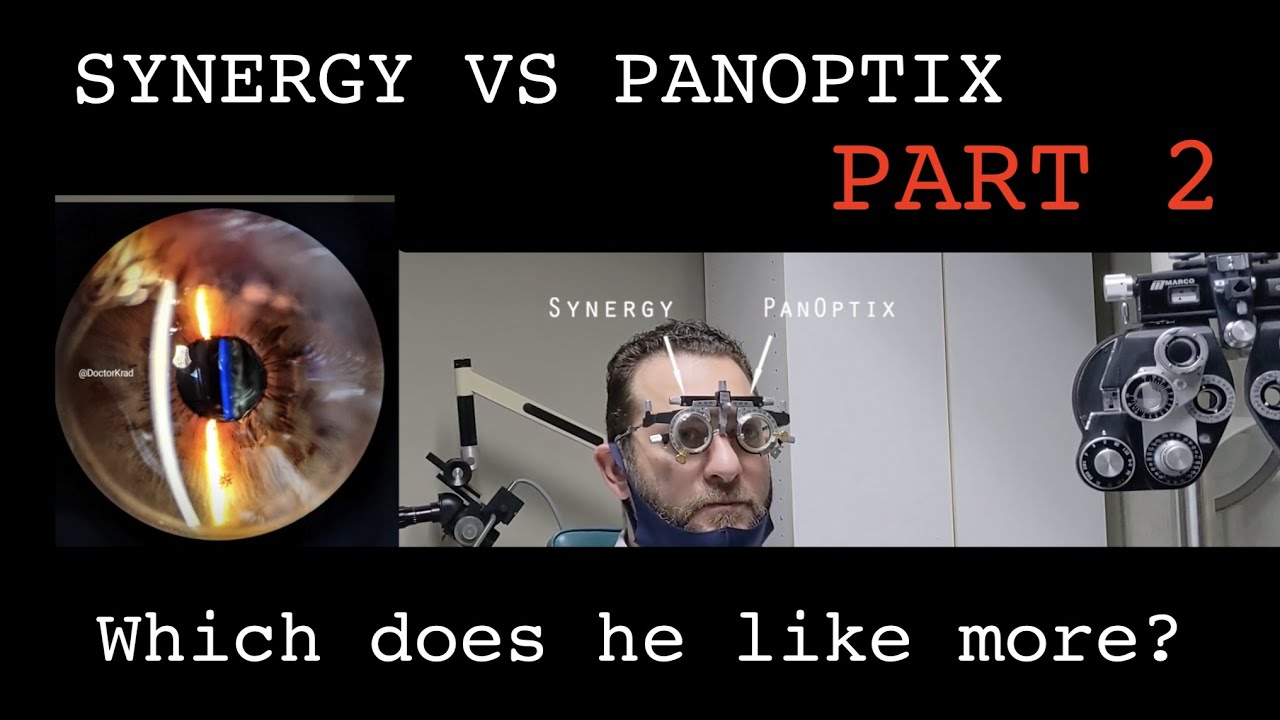
Refer to THIS video of a patient with Panoptix in 1 eye and Synergy in other eye. And refer to near the end of the video for final thoughts by the patient and by the surgeon on the Synergy.
Thanks Ron, all very good suggestions. I am now considering monofocal in the right eye when I do it (I have cancelled/delayed the surgery at this writing). I go on below but don’t feel like you need to respond. The point is I’m pretty familiar with much of this.
I did have monovision as an intended result of the Lasik surgery years ago (RE 20/20, LE less) and I liked it very much. My eyes have changed since then and as mentioned the left is now my better distance eye (because of the right eye “baby” cataract). I do use readers now for near sight (readers help the intermediate a bit too).
I do have contact lenses I got a couple years ago but have not been wearing them since covid appeared (we were told not to touch the face…). The right contact corrects to 20/20, the left is weaker, so with them in I am experiencing monovision again. I liked having them in at work or close reading, etc , and distance is great; with them I have great near, intermediate and far. Three things I do not like about these contacts though: 1) I have more trouble now getting them in and out than I did the tens of years ago when I wore them (sometimes 30 minutes taking them in and out), 2) I’m right handed–playing golf means your head is down and turned left-- judging a target distance is primarily through through the left (undercorrected) eye, which this time I have trouble doing well, and 3) I simply cannot drive at night with them in–it’s not the visual artifacts described in this portal (halos, starbursts)–it’s something else that I can’t easily describe.
" Three things I do not like about these contacts though: 1) I have more trouble now getting them in and out than I did the tens of years ago when I wore them (sometimes 30 minutes taking them in and out), 2) I’m right handed–playing golf means your head is down and turned left-- judging a target distance is primarily through through the left (undercorrected) eye, which this time I have trouble doing well, and 3) I simply cannot drive at night with them in–it’s not the visual artifacts described in this portal (halos, starbursts)–it’s something else that I can’t easily describe."
.
I have worn soft contacts since about 1975 when I got my first pair. Eventually I switched to progressive eyeglasses just out of convenience. I then got some contacts mainly for snorkeling when I go on vacation. I have actually have had some contacts dry out to end up looking like cornflakes. But, amazingly you put them in solution overnight and they are pretty good again. Then due to me getting older and less nimble with my fingers and some new contacts I got to the point I just could not get them in my eye. It was like trying to put a piece of Saran wrap in my eye. Impossible to get them off my finger and sticking to my eye. So I gave up on them again. More recently I have tried about 5-6 different contact brands and materials at Costco. The contacts I was having trouble with were J&J Acuvue Moist which are made of a hydrogel material. They are super flexible and super hard to handle. I have gone snorkeling with only one contact in, because I simply could not get both in my eyes. There is however a newer material called silicone hydrogel. They are not as flexible and are much easier to handle. They also tend to have a lower surface friction which make them in my opinion more comfortable. In my testing the Acuvue Oasis, Alcon Total 1, and Costco Kirkland Daily (CooperVision daily) were the best, and of them the Kirkland ones were best for me. They are easily the most comfortable contacts I have ever used in my 40 years or so with contacts. I typically put one contact in at 7:30 AM and don’t take it out until 10:30 PM each day. Alcon have a new one called Precision 1 which is a silicone hydrogel and should be good too (and a little less expensive), but I have not tried it. Costco carries all of these, and will give you samples to try for free.
.
I have not golfed with my monovision so I can’t really comment based on experience. I know I would see the ball on the tee perfectly. Distance judging, not sure. I use a rangefinder for shooting and I believe they sell ones for golfing which are essentially the same.
.
I also have not liked driving at night with contacts. I think they are just not as crisp and always seem to have a teary eye feeling which is exaggerated at night. In the city I drive at night with my combination of 1 contact and 1 IOL eye and find it just fine. If I was driving out of the city at night I would use my progressive glasses. During the day is no problem. One my last long trip I dodged about a half dozen deer coming out of the ditch while using the 1 contact and 1 IOL combination in the early daylight. I seem to see fine.
I wish I had found this forum sooner. I have the Synergy IOL in my left eye. It was placed about 3 months ago. My vision is not great at any distance. I see very large rings, star bursts and halos with a glare type fog around lights. I am not happy with this lens. Apparently there is a problem with the “effective position” of the lens. The ophthalmologist wants to do Lasik to correct the vision. He did not say if it would correct both near and distance. He said Lasik will reduce the dysphotopsias. If he can correct the vision and reduce the dysphotopsias as promised I will be very excited.
If anyone has expericence with Lasik reducing the dsyphotopsias please let me know.
I contacted the IOL manufacturer, Johnson and Johnson Vision, and they were of absolutely no help!
if your eye is bad at any distance then they might have screwed up for the placement. Your surgeon isnt very competent. Lasik might remove astigmatism, but it doesnt help with dysphotopsia problem. These artifacts are permanent and by design part of the lens. I have yet to see anyone with this lens say the effects are mild. All say the dysphotopasia is fairly severe.
Just keep in mind if you had the Lasik it permanently reshapes your eye. There is no going back. Find a second and third opinion outside of the surgeons in that same office, unless one of them is a professor in the field with a big university.
reading posts a few days behind. I really hope you are not going ahead with lasik to correct with this surgeon. If your vision is blurry at all distances you’ve either got too much swelling or the power calculation was way off.
It would be best if you could go back to your regular optometrist to get a refraction test and prescription. That would tell you at least if it is the power that is off.
If a mystery still get a 2nd opinion from another surgeon.
Hope you are able to figure out what is wrong
Synergy IOL installed yesterday in my left eye with incredible success!!!
The lens used was apparently a newly updated Synergy IOL - & was not pre-loaded, which might have something to do with a previous Synergy IOL that may have been harder to center in place? Not positive - the things you hear during surgery, lol. The results are MIN D BLOWING. The eye is still swollen today, inflamed a bit, a headache and scratchy kind of feeling, but those are expected symptoms post surgery, as I was fully aware of. At the first post op check-up this morning, I read the finest print on the page with my new eye - the doc said he usually doesn’t ask anyone to read the fine print 1 day post as its not fair, but he asked if it was ok to try it. I skipped to the last couple lines immediately, and read both perfectly. He was literally blown away I could read the tiniest line, at 30 cm roughly. Its important to note that generally, that’s about as close as it can focus. You can get closer vision with mono-focal lens and apparently ICals? The even better news is that the overall performance will improve over the next couple weeks and I can already read fine print. I was 99% blind in this eye yesterday morning due to a severe cataract, that typical of a 90 year old. I am 56. The eye degraded dramatically over 3 years, the last two it has been unusable to the point of causing mild hallucinations.
I have read lots of not so great stories about this IOL on this forum I can only speak from my experience thus far, which is literally, “a miracle”, to quote actor, Tim Roth. Like anything in life, it helps to have the best Ophthalmologist. The wait for this particular lens to become available in Canada, and the Superstar Doctor was painful, as he is off the charts booked - but for good reason. Completely worth the wait.
The only sad thing is, my eye with the implant is substantially better than my good eye. I will have the other eye done in roughly 2 years, as it has the beginning of the same cataract. For now, when its ok to resume my regular routine of hiking, skiing and mountain biking, I will have confidence again, with reasonable depth perception. The failing eye over the last 3 years has been responsible for at least 10 broken bones, and elbows that have developed calluses from running into doorways.
Sincerely,
A very happy customer
grich–have you had your retina checked? I’ve got monofocals, but I’m dealing with Cystoid Macular Edema (swelling of the macula) that is sometimes caused by cataract surgery. I’ve seen numbers that it only happens in 2-3% of cases, but I’ve also seen doctors with the opinion that it happens in 40% or more of cataract patients, but most people don’t recognize the symptoms or just have milder cases. Blurriness and color issues are symptoms, as is impacted close vision. I’ve had those symptoms, as well as halos/fog around lights, loss of contrast and hazy vision. It often starts showing up around 3-4 weeks after surgery. An OCT scan is one of the primary tools used to detect it. I finally got in to see my retina doc after the optometrist & surgeon’s office blew me off. A scan that probably takes less than a minute, and the retina doc had a diagnosis. Going into my 3rd week of drops, and my vision is finally starting to clear up.My surgeon did an OCT scan as part of my initial consult, so your surgeon’s office might be able to do one if you don’t have a retina specialist.
Yes CME is something to check for. The distinctive characteristic is usually that it manifests as blurred or decreased central vision (the disorder does not affect peripheral or side-vision).
“The distinctive characteristic is usually that it manifests as blurred or decreased central vision (the disorder does not affect peripheral or side-vision).”
That’s what they tell you. In my case, I had a small window in the center of my vision that was clear, and everything else (side and peripheral) was blurry. May have been a secondary issue causing it, but it’s responded to the treatment for CME (drops, drops, more drops) and I am thankful for that.
Thanks. CME isnt something they ever mention - the kindest way to interpret is to say they dont want you to worry about it. Or perhaps they dont want to scare potential patients off.
30% of patients can get it after cataract or any other form of eye surgery. First 3 months is the key period of time when it happens.
Hi, very sorry to hear about your bad Synergy experience.
I had the lens installed 6 days ago - from blind in my left eye to better vision than my right / good eye. I would call my new eye, my better eye at this point. That said, I highly recommend a second opinion - asap, before you make any quick decisions. Its possible that the lens needs to be re-positioned - I have heard of the odd person’s iol slips out of place. It also takes a long time for things to heal up - I have tons of eye junk still, and taking drops religiously 6x a day - the drops are essential. I have halos at night, they are decreasing, but I knew this going in and was prepared to live with that. My philosophy - any improvement would be better than being blind - common sense no doubt? But now, I am blown away by this lens. I don’t care about lens flares or halos at night, but they are decreasing at only 6 days post surgery and I expect that they will be easy to deal with in another week. I found the best Opthalmologist known to the Kootenays, or interior of BC. I 100% believe this was largely responsible for my success. I was reading the finest print the morning after surgery - from 99% blind. I highly recommend to get a second opinion before proceeding.